
0 Comments
Materials & quality · Buyer's note
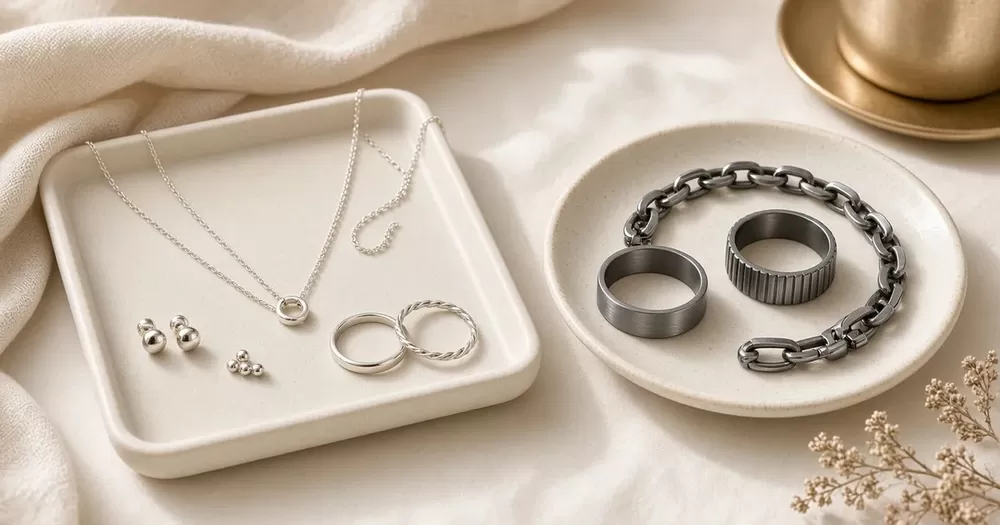
Same chain. Three names. Three prices. One of them is not what the label says.
A 40 cm curb chain quoted at $2.40, $4.10 and $7.80 from three suppliers, all described as stainless. The gap is rarely the chain. It is the alloy behind the word, and whether anyone checked the clasp that comes with it.
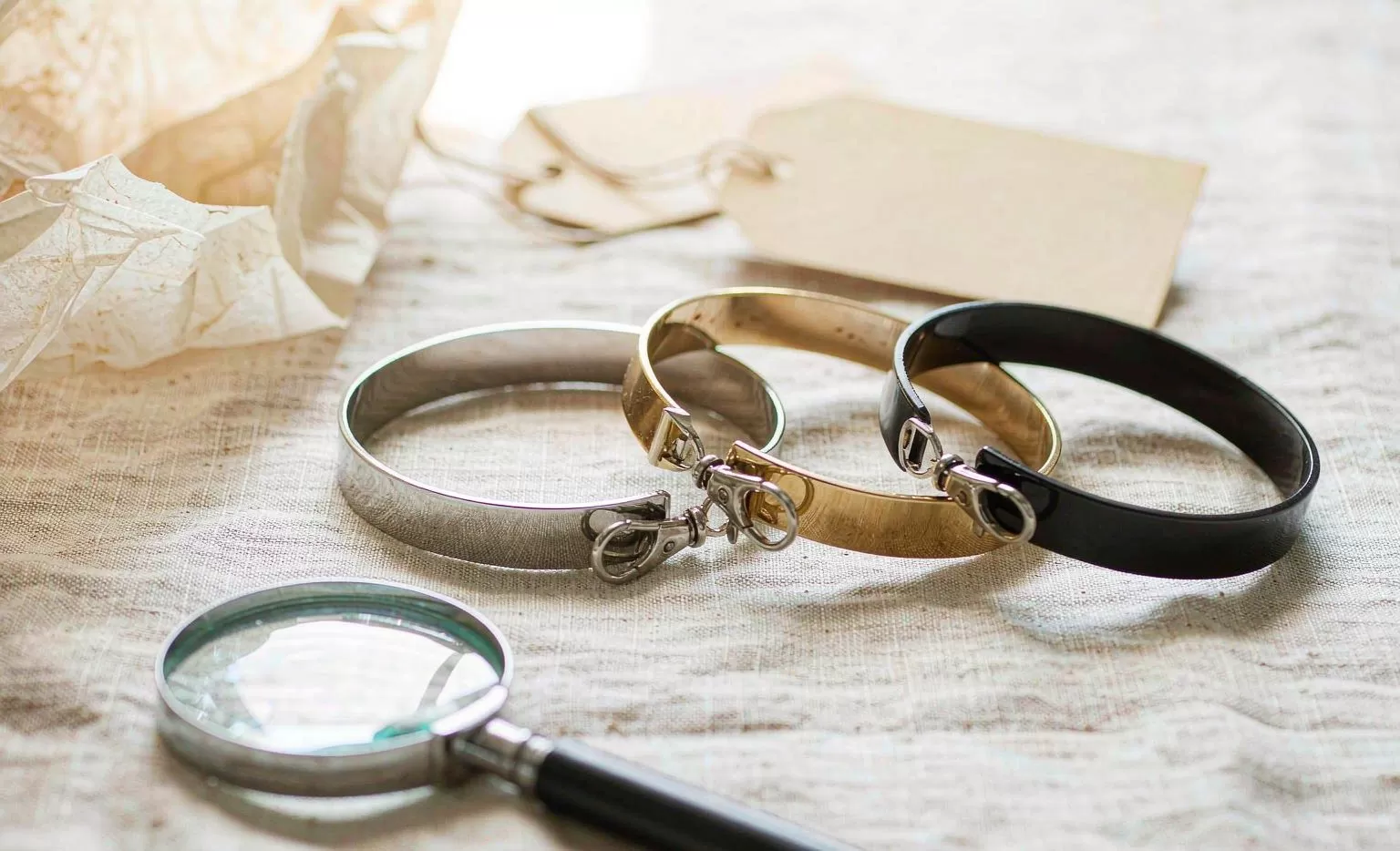 Three finishes over the same stainless base. The colour is a coating; the metal underneath decides how the piece behaves in year two.
The word that causes most of the confusion
"Titanium steel" — the phrase that shows up on thousands of wholesale listings and almost every 1688 product page — is a trade name, not a metallurgical one. In the Chinese fashion jewelry industry it nearly always refers to 316L stainless steel, the same alloy Western suppliers market as "surgical steel."
Actual titanium is a different metal with a different density, a different colour range and a different price. You will not find it in a $6 bracelet, and if a supplier says you will, the sample is the fastest way to find out.
Five materials, side by side
| Material | Nickel | Water and sweat | Plating wear | Weight | Cost band |
|---|---|---|---|---|---|
| 316L stainless | 10–14% | Unaffected | Low, if plating is good | Heavy | Mid |
| 304 stainless | 8–10.5% | Unaffected | Low to mid | Heavy | Low |
| Titanium (Ti) | None | Unaffected | Hard to plate | Very light | High |
| Brass, gold plated | Traces | Discolours early | High | Mid | Low |
| 925 sterling silver | None | Sulphur tarnish | Not plated | Mid | High |
Cost band is relative within fashion jewelry, not a price. Nickel figures are typical alloy ranges, not guarantees — ask for the mill certificate if your market requires it.
Nickel is the number that matters for returns
316L still contains nickel. Anyone selling it as "nickel free" is either misinformed or hoping you will not test. What 316L does well is hold the nickel inside the alloy: release rates are low enough to pass EN 1811 for most wearers, which is why it has a better track record than plated brass on sensitive skin. Low release is not the same as no nickel, and your product page should say so.
"Waterproof" describes the metal, not the colour
A 316L chain will not rust in the shower. The gold tone on top of it is a separate layer, a few tenths of a micron to a few microns thick, and that layer is what wears at the point where a clasp rubs a tag or a bracelet meets a desk. This is the single most common reason a customer says the piece "tarnished" — the steel is fine, the coating is gone. PVD coatings hold up measurably better than conventional electroplating, but no coating outlasts abrasion.
Cost per piece is the wrong number to compare
A $2.40 chain with a zinc alloy clasp that snaps in month two costs more than a $4.10 chain that does not, once you count the replacement, the shipping and the review. The clasp is where cheap orders fail first, and it is the part buyers forget to specify. Ask what the clasp and the jump rings are made of before you ask for a discount.
Before you confirm a sample order
Five questions that separate suppliers
Is this 316L or 304?
Both are stainless, both are sold as "steel." 316L carries molybdenum and resists chloride better, which matters for something worn against skin daily. The price difference is small; the answer tells you whether the supplier knows their own material.
Is the finish PVD or electroplated, and how thick?
A supplier who can name the process and the micron range has a real plating line. A supplier who answers "good quality, no fade" does not.
Are the clasp, jump rings and chain the same alloy?
Zinc alloy findings are the usual hidden substitution. They look identical in photos and fail differently in wear.
Can you send the nickel release test report?
If you sell into the EU or UK, this is not optional paperwork. A supplier who has the report has run the test.
Will the bulk order match the sample batch?
Colour drift between plating baths is normal. What matters is whether the supplier checks a bulk piece against the approved sample before packing, and whether you get to see that check.
How we handle it
Our catalog is built on stainless steel — 280+ styles across stainless steel bracelets, necklaces, rings and earrings, plus zirconia-set pieces. Every order is checked by hand before it ships: plating at the edges, clasp tension, stone seating. Each one goes out with a QC slip noting what was checked.
That is a small operation's answer to a big operation's problem. We are not the cheapest listing you will find for a curb chain, and we do not try to be. The $50 minimum exists so a first order can be small enough to test properly.
If you are still choosing between materials, start with the rest of our materials notes, or read our buying guides before you build the order.
Questions buyers ask us
Is titanium steel real titanium?
No. In the fashion jewelry trade, "titanium steel" is a marketing name for stainless steel. Real titanium is a different metal, roughly half the density, and far more expensive to produce and finish. Which grade of stainless is a separate question, and the label almost never answers it. Most "titanium steel" on the market is 304; some is 316L. Ask your supplier for the grade in writing before a large order, not after.
Is 316L stainless steel hypoallergenic?
It is low-release, not nickel free. 316L contains roughly 10–14% nickel bound in the alloy, and its release rate usually passes EN 1811. Most sensitive wearers are fine with it; a genuinely nickel-allergic customer may not be. Describe it accurately and you avoid the return.
Does stainless steel jewelry tarnish in the shower?
The steel does not. If a gold-tone piece dulls, it is the plating wearing at contact points, not the base metal reacting. Rinse and dry after chlorine or salt water and the coating lasts longer.
Which is cheaper for a first order, 316L or gold-plated brass?
Brass is cheaper per piece and more expensive per customer. Plated brass discolours quickly against skin and sweat, which turns a first order into a refund conversation. If your price point allows it, 316L is the safer test.
Comments
Notes appear after we approve them.
No comments yet.
Thanks — your note is waiting for review.
Please add a name, a valid email, and a message.
Please wait a moment before sending another note.