
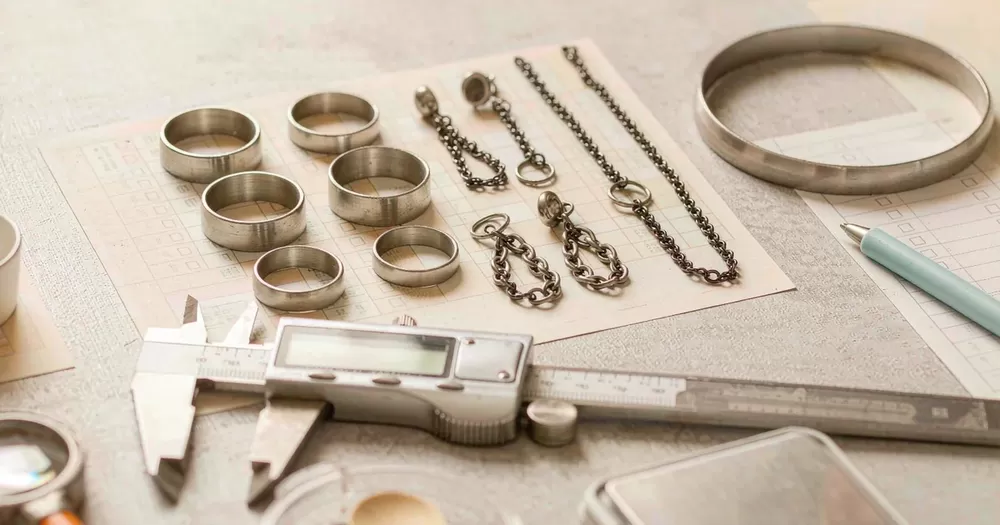
Buying guides · 2027 edition
Finding a supplier in China takes an afternoon. Finding one you can reorder from takes a method.
Search “wholesale jewelry” on any B2B platform and you get thousands of listings with the same photos at prices 3× apart. The listing does not tell you who made the piece, what it is made of, or whether order two will match order one. This guide covers how to find out before you pay.
Short answer
A reliable jewelry supplier is one that states the material in writing, ships a bulk order that matches the sample, and answers when something goes wrong. Choose the supplier type that fits your order size (factory, trading company or low-MOQ wholesaler), shortlist three, ask the same five questions, pay for samples, and judge them on the second order, not the first.
What this page covers
- What “reliable” actually means for a jewelry buyer
- Four types of supplier, and which one fits your order size
- Where China's jewelry is actually made
- Where to search: platforms, fairs and direct wholesalers
- A seven-point vetting checklist
- Red flags that end the conversation
- Samples: the only test that counts
- Payment, shipping and duties
- Compliance your supplier should already know
- A first message you can copy
- How we fit in
- Questions buyers ask us
01
What “reliable” actually means for a jewelry buyer
Most guides define reliability as “a verified badge and good reviews.” Both are useful and neither is enough. For a small store reselling fashion jewelry, reliability comes down to four things you can actually check:
- Honest specification — the metal grade, plating process and stone type are stated in writing, not implied by a photo.
- Batch consistency — the bulk order matches the approved sample in colour, weight and finish.
- Order fit — the minimum order, mix rules and lead time suit how you actually buy.
- After-sale behaviour — when a clasp fails or a parcel is short, someone replies with a fix, not an excuse.
Price is deliberately not on this list. It is the easiest thing to compare and the least predictive of whether you will still be buying from the same supplier in a year.
02
Four types of supplier, and which one fits your order size
“Supplier” covers very different businesses. Mismatching type and order size is the most common reason a first sourcing attempt fails: a factory will ignore a $300 order, and a reseller cannot give you a custom finish.
| Supplier type | Typical MOQ | Unit price | Style range | Custom work | Best for |
|---|---|---|---|---|---|
| Factory (manufacturer) | Hundreds of pcs per style | Lowest | Narrow, one material | Yes — logo, finish, moulds | Brands with proven sellers |
| Trading company | Medium, per style | Low–mid | Wide, several factories | Often, via factory | Growing stores, mixed categories |
| Platform reseller | Low | Mid | Very wide, unverified | Rarely | Trend testing, with risk |
| Low-MOQ wholesaler | Order value, not per style | Mid | Curated, mixed materials | Limited | New stores, boutiques, Etsy / Shopify |
Many “factories” on B2B platforms are trading companies. That is not a problem in itself — a good trading company adds QC and consolidation. It becomes a problem when the label is used to justify a price or a promise the business cannot keep.
03
Where China's jewelry is actually made
Knowing the clusters helps you read a supplier's address. A company that claims to make stainless steel chains in a city known for something else is worth one more question.
- Yiwu, Zhejiang — the small-commodities hub. Huge range of alloy and fashion jewelry, mostly traders, low prices, very mixed quality.
- Guangzhou, Guangdong — wholesale markets and many stainless steel and fashion jewelry workshops; Panyu district is known for silver and finer jewelry manufacturing.
- Shenzhen (Shuibei), Guangdong — the centre for gold and fine jewelry; less relevant for fashion price points.
- Dongguan and the wider Pearl River Delta — metal finishing, plating and stainless steel components that feed the cities above.
The practical takeaway: for stainless steel and plated fashion jewelry, most serious supply runs through Guangdong. Yiwu is excellent for range and trend speed, but expect to do more of your own QC.
04
Where to search: platforms, fairs and direct wholesalers
Each channel filters suppliers differently. Use at least two, so you can compare the same style from different sources.
| Channel | Language | Strength | Watch out for |
|---|---|---|---|
| Alibaba.com | English | Huge choice, trade assurance, RFQ tool | Per-style MOQs, “factory” labels on traders |
| 1688.com | Chinese only | Domestic prices, fast trends | Needs an agent; no international shipping or recourse |
| Made-in-China / Global Sources | English | More manufacturer-heavy listings | Higher MOQs, slower replies |
| Trade fairs (Canton Fair, Hong Kong jewellery fairs) | English | Handle the product, meet the team | Travel cost; booth ≠ factory |
| Direct wholesale websites | English | Low minimums, mixed carts, retail-ready photos | Check who stands behind the site |
An agent buying on 1688 can work well at volume, but you add a fee, a second QC point and a second person to blame. For orders under a few hundred dollars, the savings rarely cover the extra layer.
05
A seven-point vetting checklist
Run every shortlisted supplier through the same list. Write the answers down — you will compare them later.
1 — Is the business real and is it who it says it is?
Ask for the company name as registered and check that the payment account matches it. A mismatch between the trading name, the invoice name and the bank account is the single most common setup for payment fraud.
2 — Will they state the material grade in writing?
“316L stainless steel” or “304 stainless steel” on the quote, not “titanium steel, high quality.” If you are unsure why that matters, read 316L vs titanium steel: what the labels actually mean.
3 — Can they name the plating process and thickness?
Electroplate or PVD, and a micron range. This one answer predicts more of your return rate than any review score.
4 — Are the photos theirs?
Ask for a short phone video of the actual piece on a table, next to a ruler. Stolen studio photos are cheap; a ten-second video of real stock is not.
5 — What happens when something is wrong?
Ask for the policy on defects, short shipments and transit damage before you order. Look for a timeframe and a remedy — replacement, credit or refund — not “we will try our best.”
6 — Do they know your market's rules?
A supplier selling into the US, UK and EU should recognise nickel release, lead and cadmium limits without a long explanation. See section 09.
7 — How fast and how precisely do they reply?
Reply speed during pre-sale is the best it will ever be. If a direct question gets a vague answer now, a complaint will get a slower and vaguer one later.
06
Red flags that end the conversation
- Bank details change mid-conversation, or you are asked to pay a personal account “for a faster process.”
- “Nickel free” on 316L or 304 steel. Both alloys contain nickel; the claim tells you the supplier does not know or does not care.
- “Real titanium” at fashion prices. Titanium is far more expensive to machine and finish than steel.
- “No fade, lifetime colour” on plated pieces. Plating wears; only the rate is negotiable.
- Refusing a paid sample while pushing a bulk order with a time-limited discount.
- Prices far below every other quote for the same style. The difference is usually the alloy, the clasp or the plating, not a better factory.
A supplier that says “I don't know, let me check” is more trustworthy than one that says yes to everything.
07
Samples: the only test that counts
Order the same two or three styles from each shortlisted supplier, so you compare like with like. Pay for them. A free sample is a sales tool; a paid one shows you how the supplier handles a normal order, from invoice to parcel.
When they arrive, check what photos cannot show:
- Weight — compare the same chain from two suppliers on a kitchen scale. Lighter usually means thinner links or a different alloy.
- Magnet — 316L and 304 are only weakly magnetic. A strong pull on a “stainless” piece is a question worth asking.
- Clasp and jump rings — open and close the clasp twenty times. Check that findings match the chain.
- Plating edges — look at the inside of rings and the back of pendants under a phone torch.
- Stone setting — tap zirconia pieces gently over a table; loose stones show up immediately.
Then wear the pieces. A week of daily wear, including a shower and a workout, tells you more about plating than any spec sheet. Keep one approved sample of each style — it becomes the reference your bulk order is checked against.
08
Payment, shipping and duties
The cheapest quote can become the most expensive order once freight and import charges land. Ask every supplier to quote on the same terms.
| Question | Why it matters | What a good answer looks like |
|---|---|---|
| How can I pay? | Buyer protection depends on the method | Card, PayPal or platform escrow for small orders |
| Is shipping included? | “Free shipping” can hide in the unit price | A landed cost per piece you can compare |
| Who pays duties and VAT? | DDP vs DAP changes your real cost | Stated in writing before payment |
| How long, door to door? | Production time + transit, not transit alone | A range and a tracking number |
| What is declared on customs? | Under-declaring is your risk, not theirs | The real value and a correct product description |
Import rules for low-value parcels have changed repeatedly since 2025. The US de minimis exemption no longer applies to most parcels, and the UK and EU collect VAT at the point of sale on small consignments. Rules and duty rates in this category move faster than any article can track — confirm the current position for your country before you price a landed cost, and read our shipping policy for how we handle it.
09
Compliance your supplier should already know
You are the importer, so compliance problems land on you. A reliable supplier will recognise these without a lecture and can tell you which of their materials have been tested:
- EU and UK — nickel release (REACH, tested to EN 1811) for anything in prolonged contact with skin, plus lead and cadmium limits in jewelry.
- California — Proposition 65 warnings and limits on lead in fashion jewelry.
- US — CPSIA lead limits and testing if you sell jewelry intended for children 12 and under.
- Accurate labelling everywhere — “nickel free,” “hypoallergenic,” “gold” and “sterling” are claims, and claims can be challenged.
Stainless steel helps here: 316L is low-release rather than nickel free — it usually passes EN 1811, but ask for the report instead of assuming — and steel bases avoid the lead and cadmium risk that comes with cheap zinc alloy castings. That is one reason our catalog is built on steel.
10
A first message you can copy
Send the same message to every supplier on your shortlist. Precise questions get precise answers — and make vague ones obvious.
Hello, I run a small jewelry store selling to [country]. I am interested in [style links / SKUs]. Before ordering samples, could you confirm in writing:
- The base metal grade (e.g. 316L or 304 stainless steel).
- The plating process (electroplate or PVD) and thickness in microns.
- The material of clasps and jump rings.
- Whether you have nickel release or lead test reports for these items.
- Your minimum order, sample cost and shipping cost to [country].
- Your policy for defective or missing items.
Thank you.
Score each reply on completeness, not friendliness. The supplier that answers all six, even with “we don't have that report,” is usually the one worth sampling.
11
How we fit in
We are a low-MOQ wholesaler in Guangzhou, sourcing from the same factory network our customers would otherwise approach directly. We are not the cheapest option for 5,000 pieces of one style — a factory is. We are built for the order before that: a US $50 minimum across the whole cart, with no per-style minimum, so you can test ten styles instead of committing to one.
We answer the six questions above in writing for any listing, and each batch is checked against the approved sample before dispatch — plating at the edges, clasp tension and stone seating. If we cannot answer a question about a piece, we say so.
If you want to see how a mixed first order works, read building your first $50 cart, check our wholesale policy, or start with our stainless steel earrings, necklaces and bracelets.
Put us through the same checklist.
Send us your style list and the six questions. We will reply with the grade, the plating spec, the sample cost and freight to your country — before you pay anything.
12
Questions buyers ask us
How do I know if a Chinese jewelry supplier is legit?
Check that the registered company name matches the invoice and the payment account, ask for the material grade in writing, request a phone video of real stock, and pay for a small sample order with a protected payment method. A legitimate supplier passes all four without resistance.
Is it better to buy from a jewelry factory or a wholesaler?
It depends on order size. Factories offer the lowest unit price but usually require hundreds of pieces per style. Wholesalers and trading companies cost a little more per piece but let you mix styles and order smaller quantities, which is safer while you are still finding your best sellers.
Is Alibaba or 1688 better for buying jewelry?
Alibaba is in English, ships internationally and offers trade assurance. 1688 has lower domestic prices but is Chinese-only and does not ship abroad, so you need an agent. For small first orders, the agent fee and extra handling usually cancel the price advantage.
What is a typical MOQ for wholesale jewelry from China?
Factories commonly set minimums per style, from dozens to hundreds of pieces. Low-MOQ wholesalers set a minimum order value instead — ours is US $50 across the whole cart, with no per-style minimum.
Should I pay for jewelry samples?
Yes. Paid samples show you how the supplier handles a real order — invoicing, packing, shipping and communication. Order the same styles from each shortlisted supplier so the comparison is fair.
How long does wholesale jewelry take to ship from China?
Total time is production or picking time plus transit. In-stock items usually ship within days; express courier transit is typically about a week to major English-speaking markets, and economy postal routes take longer. Ask for a door-to-door range, not transit time alone.
Do I have to pay import duty on jewelry from China?
Often, yes. Duty and VAT or sales tax depend on your country, the declared value and current low-value parcel rules, which have changed in several markets since 2025. Confirm whether a quote is DDP (duties paid) or DAP (you pay on arrival) before ordering.
What material is best for wholesale fashion jewelry?
For pieces worn daily, 316L stainless steel with good plating is the safest all-round choice: it does not rust, has low nickel release and holds its value better than plated brass or zinc alloy. Sterling silver and titanium suit higher price points.
What should I do if my bulk order does not match the sample?
Photograph the differences next to your retained approved sample, contact the supplier within their claim window, and request a replacement, credit or refund. This is why you keep one approved sample of every style — without it, the dispute becomes your word against theirs.
Written by WholesaleJewelryOnly · Guangzhou, China
We source from the same factories our customers would approach on their own, and we have answered these questions for buyers in the US, UK, Canada and Australia. Everything on this page comes from supplier specs, our own sample checks and current import guidance — how we check a batch. Sourcing questions: [email protected]
Comments
Notes appear after we approve them.
No comments yet.
Thanks — your note is waiting for review.
Please add a name, a valid email, and a message.
Please wait a moment before sending another note.